How to follow VALORANT Champions Shanghai group stage like a pro analyst
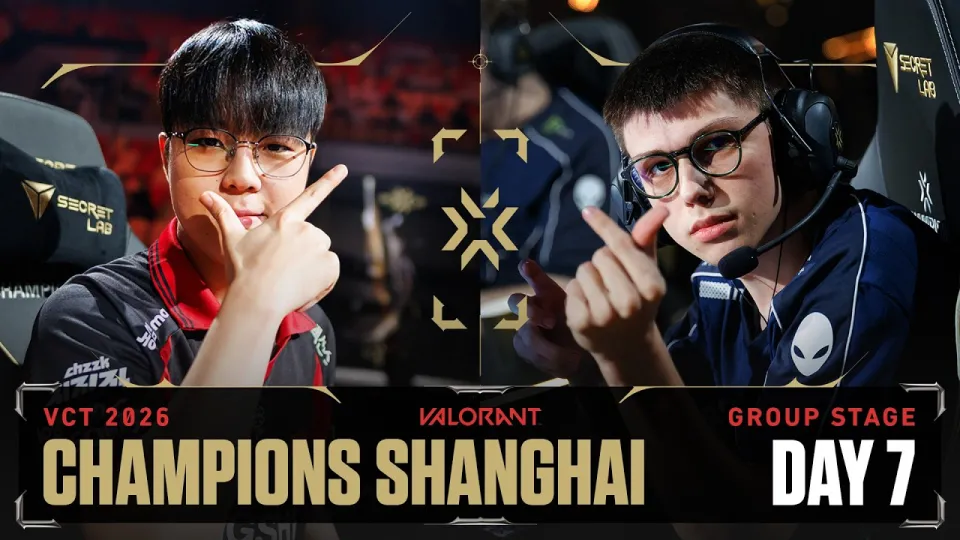
Video: VALORANT Champions Shanghai — Group Stage — Day 7
You can order the same kind of articles for your own video to boost it on YouTube and Google. Just message the Telegram bot @sat_sit_bot. The bot writes and publishes the articles itself (with your YouTube video embedded) on popular topical websites (no ads). Your first 50 articles are free.
· based on the channel VALORANT Champions Tour
Key takeaways
- VALORANT Champions Shanghai runs September 24 to October 18, with 16 teams from Americas, CN, EMEA and Pacific.
- Day 7 of the group stage was streamed by the VALORANT Champions Tour channel and drew attention for repeated tech pauses.
- Two different Masters champions in 2026 set up Shanghai as the year's biggest test of regional depth.
- Viewers questioned CN's level after lost eco and 5v2 rounds, while others argued stronger teams missed the event.
- Official updates, brackets and schedules are posted through https://x.com/valorantesports.
VALORANT Champions Shanghai is the 2026 world championship, and following it properly means tracking 16 teams from Americas, CN, EMEA and Pacific across a group stage that runs inside a September 24 to October 18 event window. The cleanest way to keep up is to pair the official broadcast with the VALORANT Esports updates on X, where schedules, results and bracket changes land first. Day 7 of the group stage, published by the VALORANT Champions Tour channel, is a useful case study in how much a single broadcast day can swing the narrative around a region.
What the VALORANT Champions Shanghai group stage actually is
The group stage is the filter that turns 16 invited teams into a playoff bracket, and the format matters more than any single highlight. Sixteen squads arrive from four regions — Americas, CN, EMEA and Pacific — and the group phase decides who advances and who goes home before the trophy rounds begin.
Key structural facts to hold onto:
- The event is the year's final VALORANT world championship, not a mid-season Masters.
- Four regions feed the same bracket, so cross-regional results are the only honest measuring stick.
- Group-stage matches are best-of-three in the standard VCT Champions format, which rewards map depth over one hot map.
- The tournament window spans September 24 to October 18, with the group stage occupying the front half.
- Partners backing the 2026 season include AWS, Coinbase, EWC, ENC, Globant, HyperX, Mastercard, OnePlus, Red Bull, Secretlab and Verizon.
That last point is not decoration: a long LAN with this many broadcast partners means long production days, and long production days mean pauses.
Why Day 7 became the tech pause conversation
Day 7 is remembered less for a single clutch and more for the number of technical stoppages that interrupted it. Viewer reaction clustered around one complaint — an apparently endless series of tech pauses — and that reaction is worth taking seriously rather than dismissing.
What actually happens during a pause:
- The observer and production crew hold the broadcast while the server or client state is verified.
- Players stay in comms but lose the rhythm of a live round sequence.
- Coaches get an unplanned timeout, which can quietly reset a team's economy planning.
- Viewers who joined for a specific map often drift away, which distorts later engagement numbers.
For anyone watching a VOD rather than the live feed, this is mostly a navigation problem. Community-made spoiler blockers and timestamp lists exist precisely because a four-plus hour broadcast with dead air is hard to scrub. If you are watching Day 7 after the fact, treat the pause clusters as chapter breaks and jump between them.
How to read a group stage day without the casters
Reading a group-stage day on your own is a skill, and it starts with ignoring the scoreline until you know the map pool. A 2-0 tells you almost nothing if you do not know which team picked which map and whether the opponent's perma-ban was respected.
A repeatable checklist:
- Note the pick-ban order before the first pistol round; it predicts the series better than any pre-match ranking.
- Track eco and semi-eco conversion — the single most reliable signal of a team's discipline.
- Watch retakes rather than entries; group stage results are usually decided by post-plant decisions.
- Log every 5v2 and 4v2 loss; those rounds are where a struggling team's structure shows.
- Compare a team's utility usage on attack against the same map from a different region that day.
The viewer discussion around Day 7 leaned hard on exactly these points. Critics of the CN representatives pointed to lost eco rounds, blown 5v2 advantages and a lack of creativity once set strategies broke down. That is a fair analytical lens — but it is also the lens that gets applied to every region when it loses, and it says more about preparation depth than about raw aim.
The regional depth argument behind the criticism
Regional depth is the real argument underneath the noise around the CN results, and it is a legitimate one. A recurring viewer objection was that several teams from other regions looked stronger than the CN representatives yet did not qualify for Champions at all. That is a qualification-format question, not a performance question, and the two get mixed together constantly.
How to separate them:
- Qualification strength is about how many slots a region gets and how brutal its domestic path is.
- Event performance is about what a team does once it is on the Shanghai stage.
- Depth is about the fourth and fifth seed in a region, not the first.
A region can be genuinely deep and still send a representative that collapses in groups; a region can be shallow and still send one team that overperforms. Day 7 gave ammunition to both readings, which is why the debate ran so long in the comments rather than settling.
Individual players and the small moments that travel
Individual plays travel further than results in a group stage, and Day 7 produced the usual crop. One widely shared moment involved a Yoru clone that briefly looked, in the middle of a chaotic round, like it was helping hold a site — the kind of accidental comedy that only a utility-heavy agent produces.
Other threads worth following through the group stage:
- Veteran duelists and initiators whose value shows up in retakes rather than highlight reels.
- Sentinel players who quietly hold a site alone for four rounds and never appear in a montage.
- Coaches' timeout usage, which is often the difference between a 13-11 loss and a 13-9 win.
If you want to evaluate a player from a VOD, watch their off-round movement and their utility timing, not their frag count. A player can top-frag a loss and still be the reason the team lost map control on three separate executes.
Useful links for following the event
The official channels are the fastest route to schedules, brackets and broadcast times, and they are worth bookmarking before the playoff stage begins.
- https://x.com/valorantesports
- https://www.facebook.com/ValorantEsports/
- https://www.instagram.com/valorantesports/
- https://www.tiktok.com/@valorantesports
- https://www.twitch.tv/valorant
For written coverage between match days, the official news hub at https://www.valorantesports.com/news carries announcements and recaps.
What Day 7 tells us about the rest of Champions
Day 7 is a reminder that the group stage of VALORANT Champions is where narratives get rewritten faster than rankings can keep up. Two different Masters champions in 2026 already broke the assumption that one team would simply carry the year, and Shanghai is the stage where that instability either resolves or explodes. The broadcast itself — long, pause-heavy, full of small mechanical moments — is still the best available data source, provided you watch it with a checklist instead of a scoreboard. The VALORANT Champions Tour channel produced the Day 7 broadcast and remains the reference point for the full group stage run. If you want to stay current as the bracket fills out, follow the official VALORANT Esports account on X for schedule and result updates.
Questions & answers
What is the format of the VALORANT Champions Shanghai group stage?
Sixteen teams from Americas, CN, EMEA and Pacific are split into groups and play best-of-three series to decide who advances to the playoff bracket. The group stage sits in the front half of the September 24 to October 18 event window, with the trophy rounds following.
Why were there so many technical pauses during Day 7?
Broadcast days at a long LAN involve server verification, observer checks and production resets, and any of those can stop a map mid-round. Day 7 happened to stack several of them, which is why viewers noticed the dead air more than usual. Pauses also hand teams an unplanned timeout, which can shift economy planning.
Are the CN teams really weaker than teams that missed Champions?
That is a qualification-format question as much as a performance one. A region's slot count and domestic path determine who attends, while event performance is judged only on the Shanghai stage. Day 7 exposed real issues — lost eco rounds, blown 5v2s, rigid set plays — but those are preparation problems that any region can show on a bad day.
Where can I watch the group stage VODs and get schedule updates?
The VALORANT Champions Tour channel hosts the full broadcast VODs, including Day 7. For schedules, brackets and announcements between match days, the official account at https://x.com/valorantesports and the news hub at https://www.valorantesports.com/news are the fastest sources.
Source: VALORANT Champions Shanghai — Group Stage — Day 7 · Markdown version